VidaiAssistant · A separate product from Vidai
An expert assistant for work that can't go to the cloud.
A desktop app for engineers who work from manuals, datasheets and schematics, often somewhere with no connectivity at all. It answers from your documents on the machine in front of you, cites every claim, and nothing leaves it. It stands on its own: no gateway, no Control room, no network.
The problem
A general chatbot fails the moment it matters.
01
It guesses, fluently
A general model fills gaps with plausible text. Where a wrong figure has consequences, plausible is the failure, not the success.
02
The capable model is on the wrong side of the wall
The vision model that reads a schematic well runs in someone's cloud. The model you can run offline is small, and weak at a dense diagram unless something prepares it first.
03
It needs the internet
Hosted assistants assume a connection and send your documents to someone else's servers. In an air-gapped or sovereign setting, that rules them out.
The core behaviour
Backed by evidence, or it refuses.
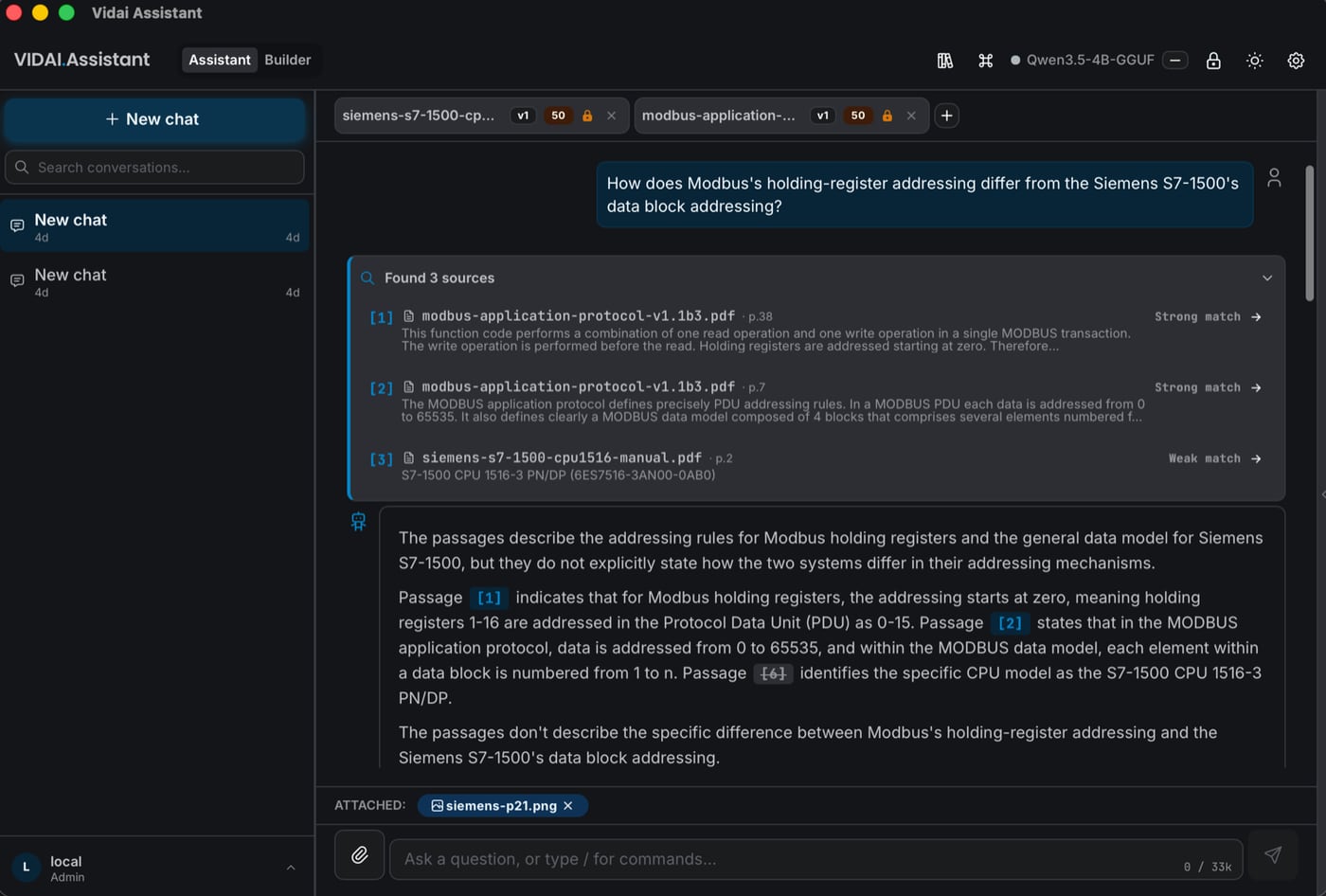
Every claim is tied to a numbered citation that opens where it came from, so an answer is something you can defend in a review. When the evidence isn't there, it returns INSUFFICIENT EVIDENCE rather than improvising.
- A sources card appears before the answer: what was found, and how strongly it matched.
- Unsupported claims and invented citation markers are removed after generation, not left to the model's good intentions.
- A confidence mark sits on every answer; when it's low, the evidence is promoted and the prose is played down.
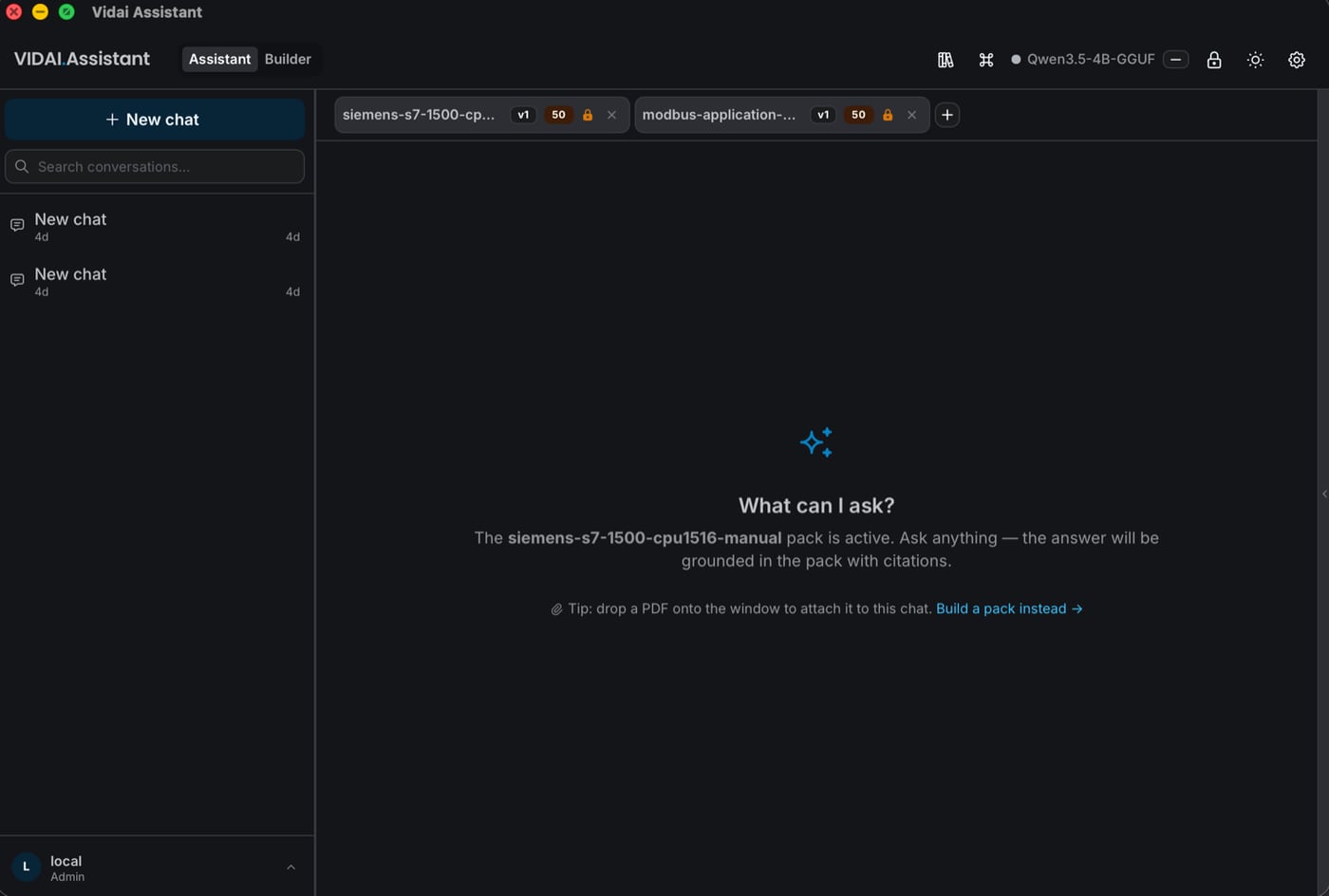
- With a knowledge pack, answers are grounded and cited. Without one, it answers from general knowledge behind a clear disclaimer. The two are never mixed.
It reads the drawing
Ask about the schematic. Get the schematic's answer.
- Schematics and figures are captioned and read into the search index when a pack is built, so a question can be answered from a drawing, not only from the text.
- Drop a schematic or a photo into a conversation and ask about it, with the same citation discipline.
- When it answers from a caption made at build time rather than from the image itself, it says so.
- A visual answer points back to the page and figure it came from.
The knowledge pack
Build it once. Query it anywhere.
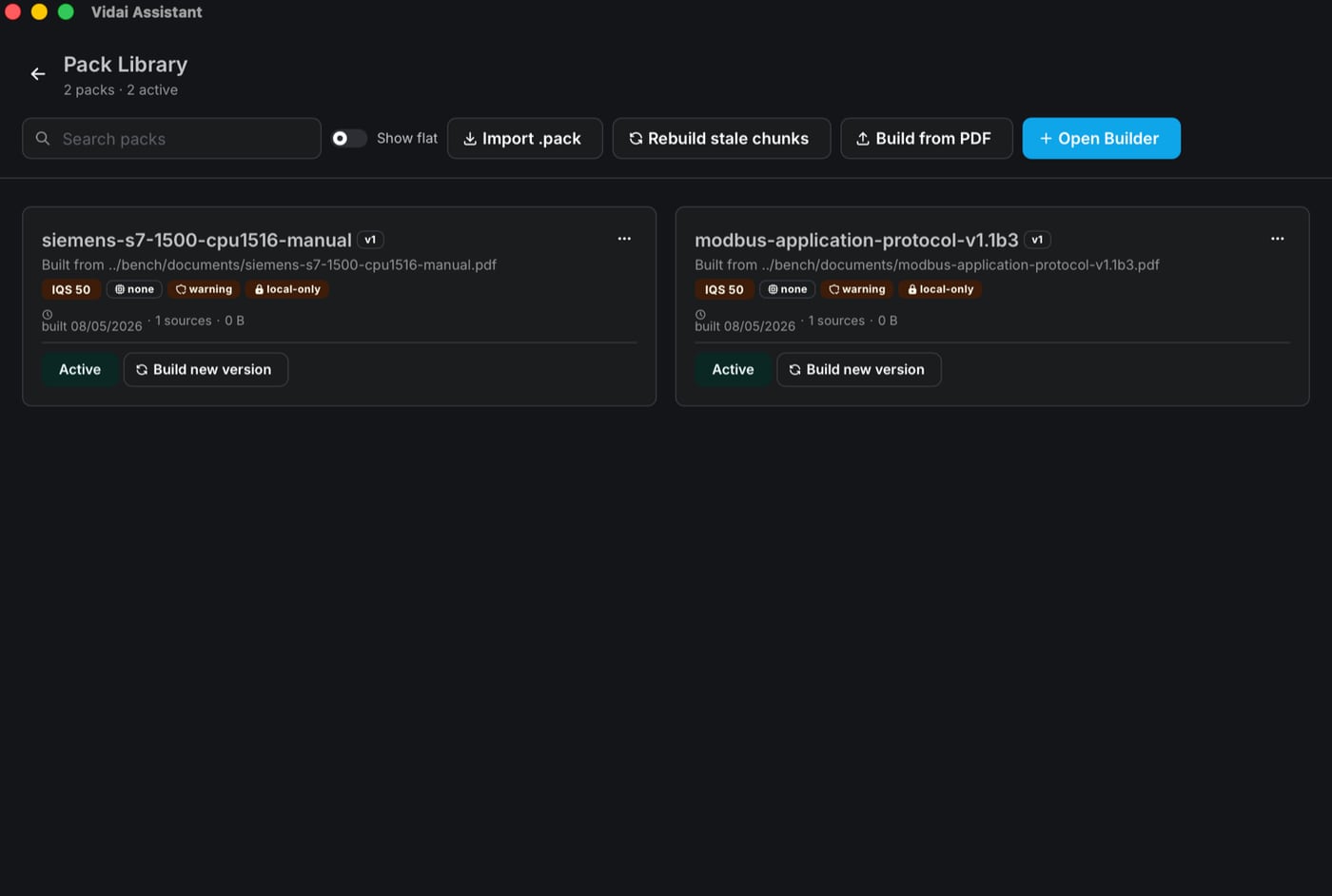
A pack is one portable file: the documents, the search index, and a record of exactly how it was built. Build it on a workstation, copy it to a USB stick, open it on a laptop with no network.
- Immutable and versioned: a rebuild makes a new version with lineage back to the original.
- A manifest inside the pack records how it was built: source hashes, embedding fingerprint, build settings and signature status.
- The original documents travel inside the pack, so every citation can be traced to the source.
- An index quality score shows where the index is strong and where it's thin, before you trust an answer from it.
Air-gapped by construction
It can't phone home, because there's no home to phone.
Egress lock
When locked, only local endpoints are allowed. A padlock shows the state, and unlocking asks you to confirm, in words, that data may leave the device.
Per-pack egress policy
A pack can forbid any non-local model. While it's active, every remote option is greyed out: the policy lives on the knowledge, not the app.
No telemetry
No usage callback, no analytics beacon, no licence ping. There's no outbound call to switch off, because none is written.
Encrypted at rest
With a passphrase set, messages and profiles are encrypted (AES-256-GCM, with an Argon2id-derived key). The passphrase is never stored.
No infrastructure
An app on the laptop in your hand, not a platform to stand up.
One desktop app
An engineer installs and runs it themselves: no server, no cluster, no account, no operations team.
A modest laptop
Answers come from a small local model. The heavy extraction happens once, when the pack is built, on bigger hardware.
On a USB stick
A pack is a file. Carry it to a machine that has never touched a network, and it works the same.
No fine-tuning
Your knowledge is indexed, never trained into a model. A corrected datasheet means rebuilding a pack in minutes, not a training run.
Precise where generic search fails
- Keyword and vector search are combined, then a reranker checks for precision.
- Extracted relationships let a question about a component reach the interface it connects to, not just paragraphs that share its words.
- Tuned for the single-fact question: “what voltage does pin 3 run at” returns the line and the page.
Shared, regulated machines
- Each user's history and profile is encrypted to them.
- The one admin can create, disable and remove users, and nothing else: there's no way to view another user's work in the code.
- It says plainly what its encryption protects against, and what it doesn't.
- A “don't save this session” option keeps a conversation in memory only.
A separate product
Not part of the Control room. Doesn't need it.
VidaiAssistant isn't a feature of the Vidai gateway or the Control room, and doesn't connect to them. It's a desktop app of its own, for the case where there's no network at all. If you're looking for something like it, this is what we built.
What the two share is a stance: your data stays with you. The Control room keeps an organisation's AI traffic inside its own network; VidaiAssistant keeps one engineer's work on one machine. It grew out of our engineering work for sovereign customers.
VidaiAssistant