
Resource · ISO/IEC 42001
ISO/IEC 42001 is the AI bar you can't backfill.
The new AI management system standard is already in enterprise RFPs and vendor security reviews. The operational evidence it asks for has to already exist. Vidai records it from day one and is precise about exactly which controls it covers.
What it is
ISO 27001, but for running AI responsibly.
ISO/IEC 42001:2023 is the international standard for an AI Management System: how an organisation governs, operates and is accountable for the AI it runs. Annex A defines 38 controls across nine groups. It is becoming the thing boards, auditors and enterprise procurement ask for, the way ISO 27001 did for information security.
It's a procurement reality
It is already appearing in enterprise RFPs and vendor security reviews. "How do you govern your AI?" is now a question with a standard behind it.
Evidence is operational
A large share of the controls are about what your AI systems actually did, logged, monitored, accountable. That evidence is a record, not a policy document.
You can't backfill it
You cannot manufacture a year of operational evidence the week before the audit. The record has to have been kept all along.
Where Vidai fits
We don't certify you. We make the evidence inevitable.
Vidai is not an ISO 42001 certification and does not make you "ISO 42001 compliant", by design, the product literally cannot express that. What it does is collapse the slowest, most manual part of readiness: for the controls where Vidai sits in the AI request path, the evidence is produced continuously, automatically, as a queryable record.
The mapping, exactly
Four controls where Vidai is the record.
For these, you do not assemble evidence. You point the assessor at Vidai.
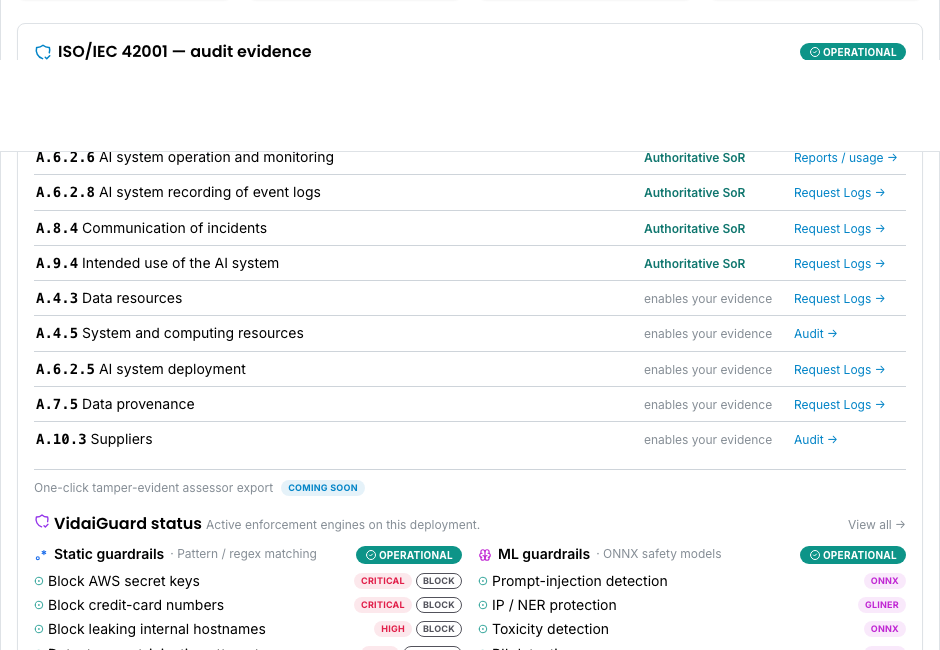
Plus five controls where Vidai supplies the evidence primitive: A.4.3, Data resources · A.4.5, System and computing resources · A.6.2.5, AI system deployment · A.7.5, Data provenance · A.10.3, Suppliers. The remaining 29 Annex A controls are organisational process, your scope, not ours, and the product shows it that way rather than claiming false coverage.
Honest about the export
Real evidence today. We won't dress it up.
Speed up your ISO 42001 readiness.
A 20-minute walkthrough: the control mapping, the operational evidence, and exactly where the boundary is.