
Finance & the CFO
Observe. Attribute. Act.
See every dollar your AI spends, attribute it to the exact agent, application, team or key that spent it, and stop the overrun before it happens. Most tools only do the first part, after the invoice.
The problem
Billing blindness costs you a quarter.
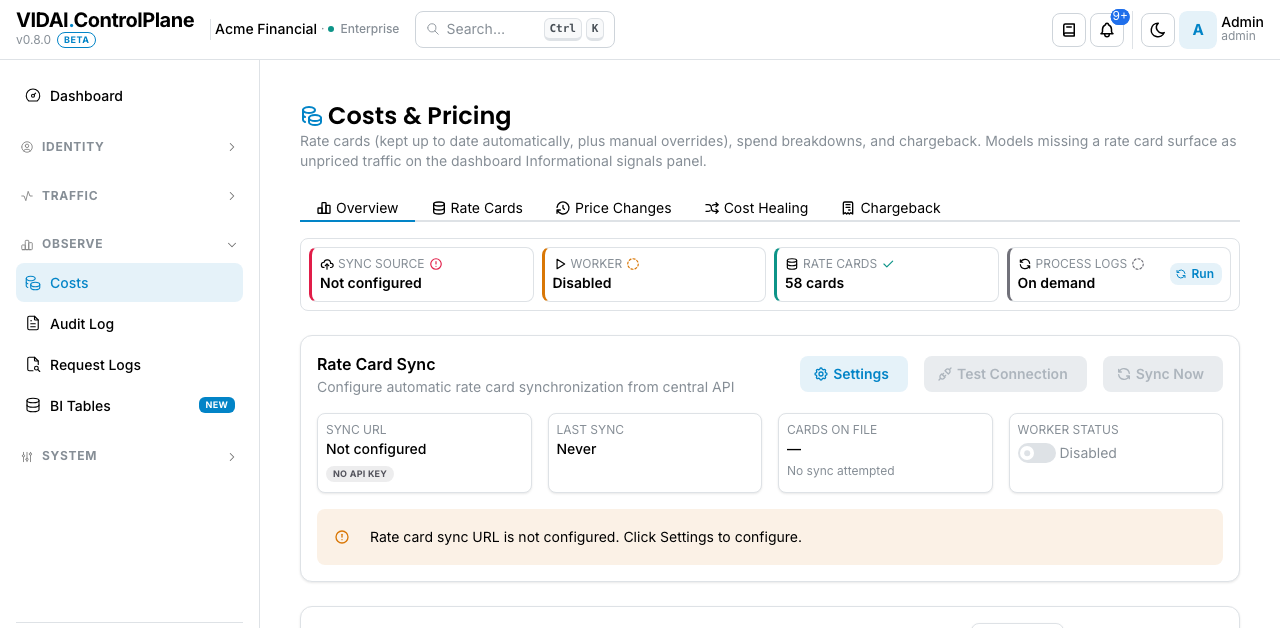
Four provider invoices, no attribution, a spreadsheet nobody trusts, and a vendor that moved prices mid-quarter so last quarter's numbers are wrong anyway.
The live ledger
Every request, priced the moment it happened.
Not "last sync." The moment the call returned, it was priced and attributed to the user, key, team, application, model and project that made it. So "what did Risk spend on Claude last month" is a query, not a forensics project.
Enforced spend control
Seeing the overrun is too late.
A cap that acts, not an alert that pings.
Everything so far was about seeing the spend truthfully. This is the part that protects it: Vidai's spend controls are enforcement, sitting in the request path and changing what happens before the next expensive call is ever made.
SCD2 rate cards
A rate history that survives a price change.
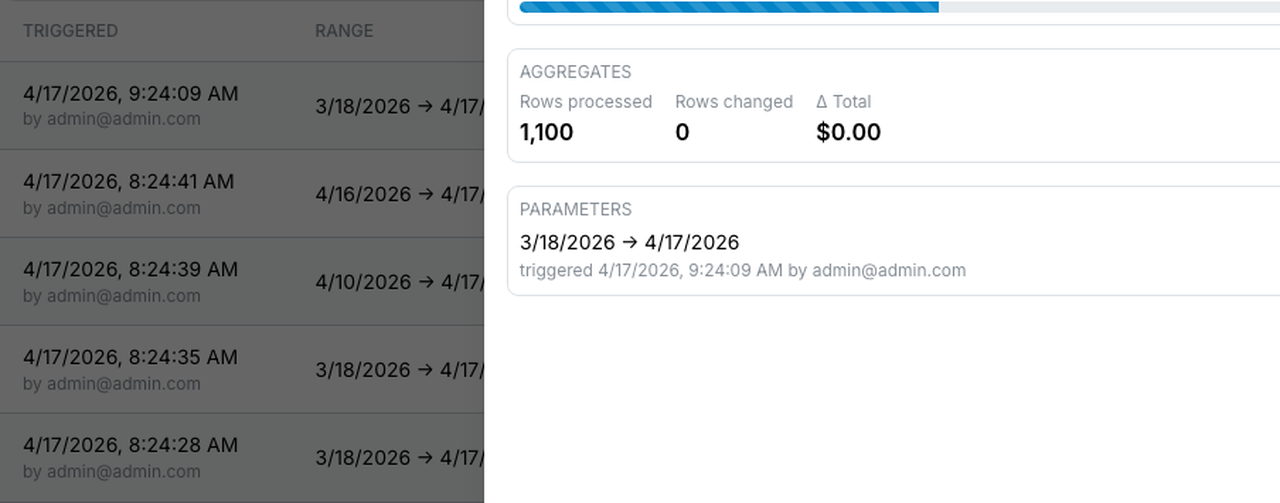
Rate cards are time-versioned with Type-2 slowly-changing dimensions: the same audit-grade schema your data warehouse already uses for historical correctness.
When a vendor's price moves, the old card closes with an end date and a new one opens. You can always answer, for any call ever made, "what rate was active when this was priced, and why?"
Your rates, your way
Negotiated enterprise rates, not list prices.
Vidai hosts a maintained price catalogue so a fresh deployment is priced on day one, with no setup.
But you almost certainly don't pay list price. Register your negotiated enterprise rates as overrides, per provider, model, tier and modality. They take precedence at lookup time. A six-step resolver guarantees a call is never silently left unpriced.
Cost Healing
Re-price the past when the present changes.
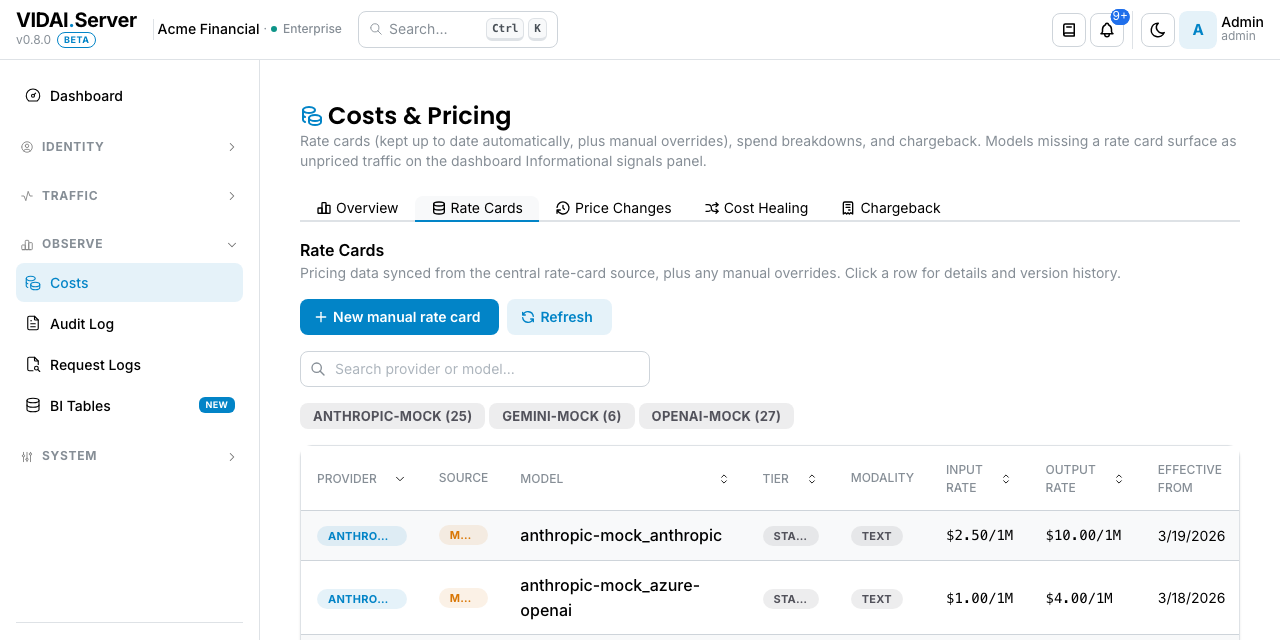
A vendor moved prices, or you corrected an override. Run a healing pass over the affected window. Dry-run to see the per-row before/after delta, commit when it's right. No silent rewrite, no "trust me."
What-if analysis
Decide on numbers, not a hunch.
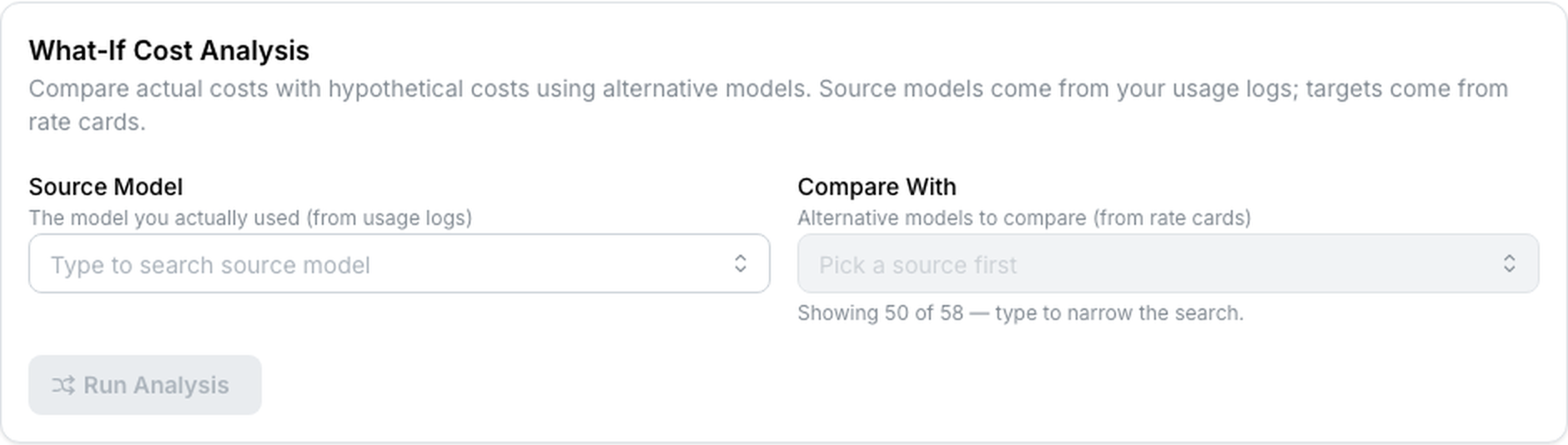
"Should we switch this model?" Pick the model you actually use, pick the alternatives, run the analysis against your real logged traffic.
The result is a table: hypothetical cost, savings, percentage, per candidate. mistral −70%, gpt-4o-mini −25%, o3-mini +1024%. The ledger is never touched.
Cost-based routing
Routed to the cheapest model that fits, automatically.
What-If tells you which model would have saved how much. Cost-based routing applies that on every call from then on. Each request goes to the cheapest model that meets the policy and quality bar you set: not the one the application happened to hardcode.
Chargeback
Who spent what, exported to your billing.
Top spenders by group, user, API key, application or model, in any window. Export the CSV with key, owner email and cost, straight into your showback system. Finance-ready, not a screenshot of a chart.
Why it matters to finance
The 2am agent can't blow the budget.
You see every dollar, attributed, the moment it's spent. And the runaway agent that used to surface on the invoice is stopped in minutes, because Vidai already acted. Seeing it and controlling it are the same system, on your own infrastructure. That is the difference between a cost dashboard and a cost engine.
See it and stop it, on a real deployment.
A 20-minute walkthrough: chargeback, a price-change heal, a what-if, and a spend circuit tripping live.