
Sovereignty · the offline member of the family
An answer you can defend, on a laptop with no network.
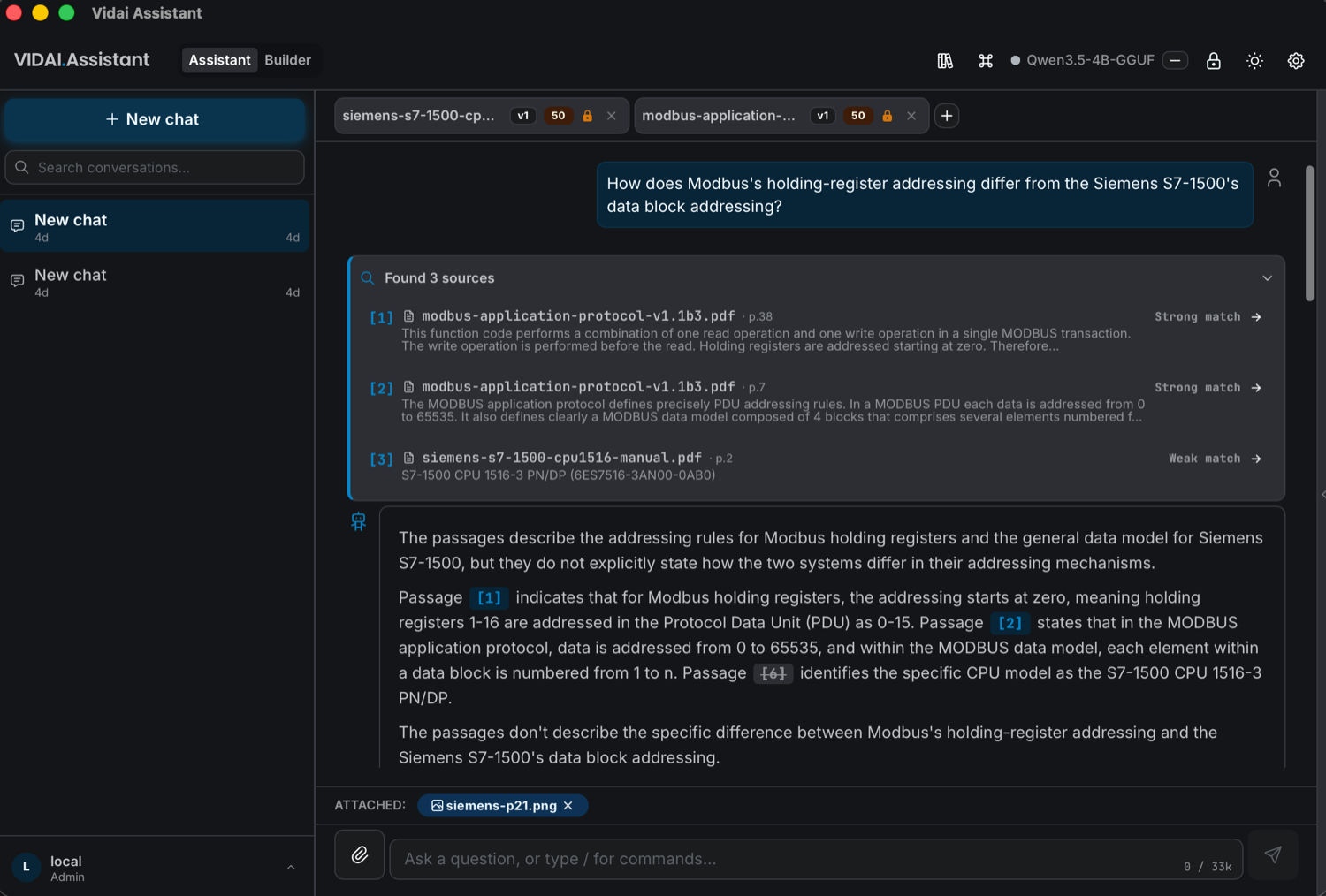
A sovereign expert assistant for the work that can't go to the cloud. Every claim is backed by evidence you can check, and when the evidence isn't there it says so instead of inventing one. Nothing leaves the machine.
The problem
A general chatbot fails the test the moment it matters.
Engineers work from manuals, datasheets and schematics where a wrong figure has consequences, often in regulated settings, or somewhere with no connectivity at all. The frontier model that could help lives in the cloud, exactly where this work can't go. It's a liability there, not a productivity tool.
It guesses, fluently
A general model fills gaps with plausible text. In a domain where a wrong figure has consequences, "plausible" is the failure mode, not the success one.
The capable model is the wrong side of the wall
The vision model that reads a schematic well runs in someone's cloud. The model you can run offline is small, and weak at a dense diagram unless something prepares it first.
It needs the internet
Hosted assistants assume egress and send your corpus to someone else's servers. In an air-gapped or sovereign environment that rules them out entirely.
The core behaviour
Backed by evidence, or it refuses.
Every claim in an answer is tied to a numbered citation that clicks through to where it came from, so the answer is something you can defend in a review, not just read. When the evidence isn't there, VidaiAssistant returns INSUFFICIENT EVIDENCE rather than improvising to fill the silence. Better to refuse than to lie.
It reads the drawing
Ask about the schematic. Get the schematic's answer.
Engineering knowledge doesn't live in prose alone. The trick isn't a bigger model on the laptop, it's doing the heavy visual understanding once, at pack-build time on capable hardware, so the small offline model can answer from a diagram it could never have read on its own. Point it at a schematic and ask; the answer is grounded in what the drawing shows, and it cites the figure.
The unit of knowledge
Build the pack once. Query it anywhere.
A pack is one portable file: the engineering corpus, the search index, and a manifest that records exactly how it was built. Build it on a capable workstation, copy it onto a USB stick, open it on a laptop with no network. The heavy work happens once, off the field machine.
The library
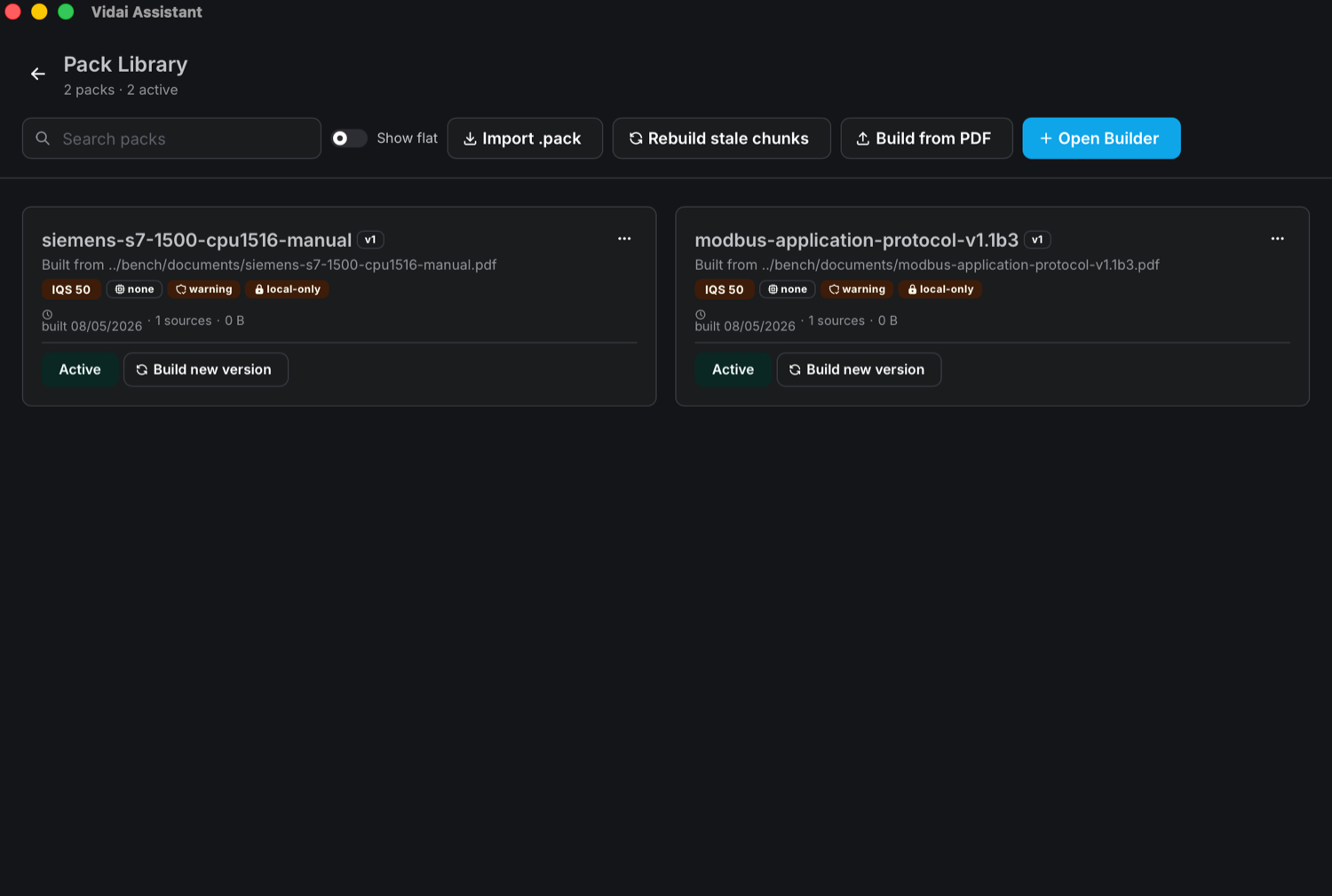
Every pack carries its own provenance.
Quality score, version lineage and egress policy are visible on the pack itself, not buried in a settings screen. You manage knowledge, not files.
Air-gap by construction
It can't phone home, because there's no home to phone.
Offline isn't a setting you trust the vendor to honour. It's enforced in the code path, and you can verify it on the wire.
egress: forbidden. While it's active, every non-local inference option is greyed out. The policy lives on the knowledge, not the app.No infrastructure
It's an app on the laptop in your hand, not a platform to stand up.
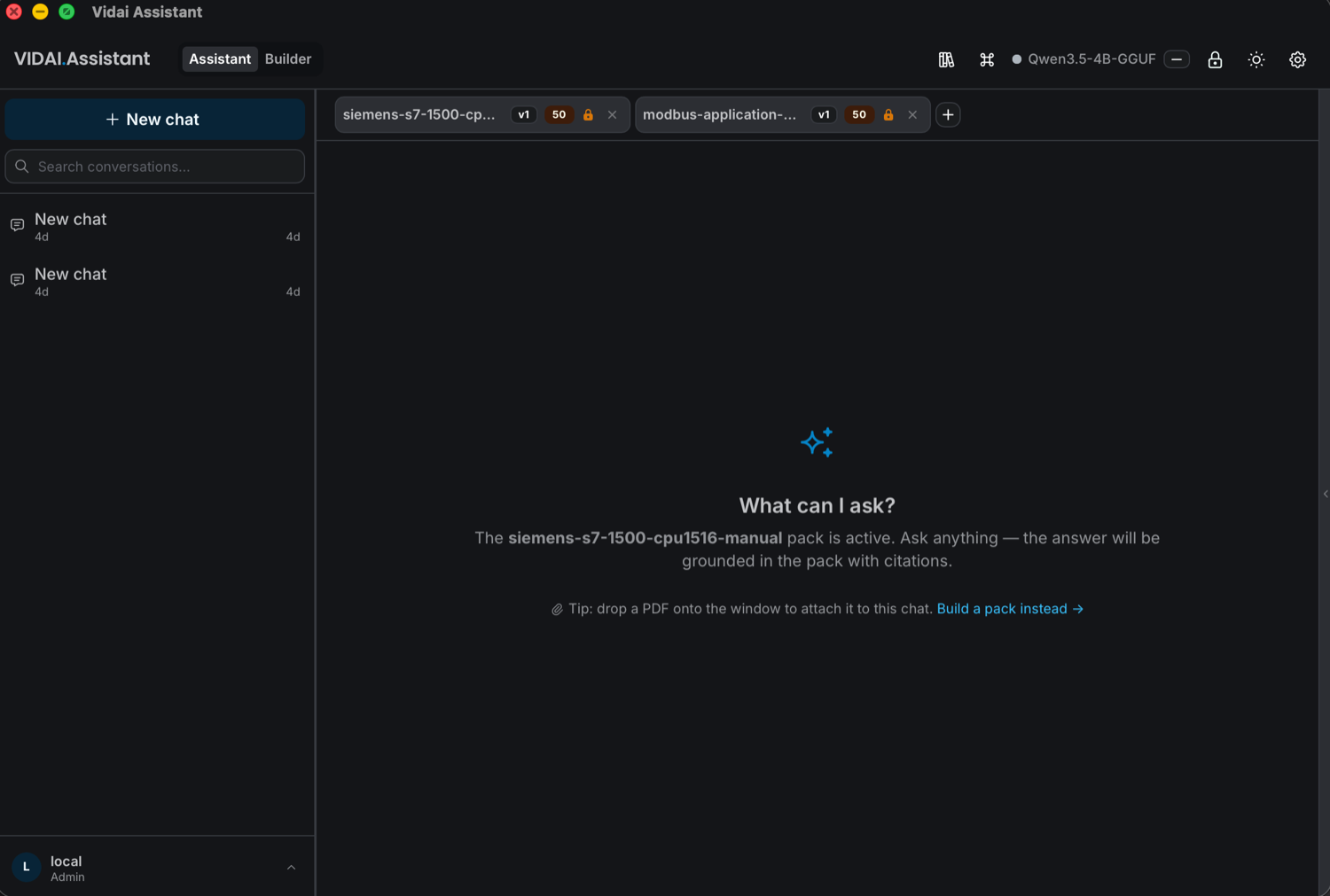
Double-click and it opens. No server to provision, no cluster, no account, no connection, no datacentre burning power behind it. One person, one machine, one signed pack, it fits the case where IT isn't in the room and the network isn't there.
No fine-tuning
Index the corpus. Don't retrain the model.
You never fine-tune or retrain a model on your data, no training run, no GPU weeks, no proprietary knowledge baked irreversibly into weights you then have to govern. New knowledge is a new pack. The retrieval pipeline does the work, and it's built to be precise where a generic vector search quietly fails.
Shared, regulated machines
Multiple users on one laptop, no surveillance.
When a single machine is shared, separation has to be real. Each user's history and profile is keyed to them and encrypted. There is one admin, and the admin has no power to read anyone else's work.
Where it fits
The same sovereignty stance, in a single binary.
VidaiServer keeps your AI traffic inside your boundary, in the path of every AI request. VidaiAssistant carries the same principle to the edge case where there is no network at all, a desktop tool you run on your hardware, over a corpus you built and signed. It grew out of our sovereign engineering work and is part of the same sovereignty answer.
See it answer, and see it refuse.
A short walkthrough on a pack built from engineering material that looks like yours, cited answers, the refusal behaviour, and a question answered from a schematic, live.